• Products
  • Services
  • About us
  • Blog
27 May 2026

Industrial ceramic glazes: a complete guide to composition, processes and applications

Ángel Campillo

Written by

Ángel Campillo

Share

Ceramic glazes are one of the key elements in the industrial manufacturing of tiles and other ceramic products. They do not only define how a surface looks, but also how it behaves against wear, moisture, abrasion, cleaning or the passage of time.

In a ceramic production line, the glaze is much more than a finishing layer. It is a technical solution that must adapt to the body, the process, the design, the firing and the final performance required by each piece.

That is why talking about ceramic glazes means talking about balance: between aesthetics and performance, between formulation and application, between creativity and industrial control.

Key ideas on industrial ceramic glazes

  • They are both a technical and aesthetic layer. They protect the surface, but also define colour, gloss, texture and final finish.

  • They must respond to the actual use of the piece. The demands on a high-traffic floor tile are not the same as those on a decorative wall tile or a piece for wet areas.

  • Composition is decisive. Frits, raw materials, pigments, grits and additives combine to achieve a specific response in application, firing and use.

  • The glazing process requires control. Density, viscosity, flow rate, body, temperature and application method can all change the final result.

  • Firing defines the final glaze. During vitrification, the glaze develops its appearance, compaction and final performance.

  • Choosing the right glaze is a strategic decision. It affects product quality, line efficiency and the differentiation of the collection.

What exactly are ceramic glazes and what is their function?

When we talk about what ceramic glazes are, we refer to coatings applied onto a ceramic body which, after firing, form a vitrified or partially vitrified layer on the surface.

In simple terms: the glaze is the layer that transforms a ceramic piece into a technical and aesthetic surface.

Its function is twofold. On the one hand, it has a technical function, helping to improve impermeability, chemical resistance, wear resistance, ease of cleaning and the surface behaviour of the piece. On the other hand, it has an aesthetic function, because it defines the colour, gloss, texture, visual depth, feel and final finish.

In the ceramic industry, this dual function is critical. A technical or production manager cannot choose a glaze based solely on its appearance. They must ask themselves whether it will work on the line, whether it will be stable during application, whether it will respond well during firing, and whether it will maintain the expected performance in the final product.

A glaze may look correct in an initial test, but if it generates shade variations, application problems, surface defects or a lack of repeatability, it ceases to be a viable solution.

That is why, in industrial ceramics, the glaze is not understood as an isolated product. It is understood as part of a complete system: body, engobe, application, decoration, firing and final use.


Key composition: what a high-performance glaze is made of

An industrial ceramic glaze is a complex formulation. It is not simply a matter of mixing materials and applying them to a piece. Every component has a function, and every adjustment can change the final result.

In general terms, glazes can be formulated with frits, raw materials, additives and ceramic pigments. The ITC (Institute of Ceramic Technology) notes that a significant proportion of the frits produced are used in glaze compositions, combined with other raw materials, additives and ceramic colours.

To understand how they interact, here are the essential components and their specific function within the glaze:

  • Frits: They help form the glassy phase and determine gloss, transparency, resistance and maturing temperature.

  • Raw materials: They adjust the behaviour of the glaze during application, firing and final finish.

  • Ceramic pigments: They provide colour and chromatic stability depending on the temperature and the glaze base.

  • Granules and microgranules: They add texture, relief, gloss, sugar effect, matt finish or specific performance characteristics.

  • Additives: They improve suspension stability, application and glazing line behaviour.

The key lies not only in choosing good components, but in formulating them to work together. A high-performance glaze must be stable during application, compatible with the body, and capable of maintaining the desired finish after firing.

The role of frits in glaze quality

Frits are one of the most important components in ceramic glazes. They are obtained by melting raw materials at high temperatures followed by rapid cooling, generating a vitreous material that is then milled and incorporated into ceramic formulations.

Their role is essential because they help control the formation of the vitreous phase, fusibility, chemical stability and many of the glaze's final properties. In ceramic tile manufacturing, frits are a key raw material for formulating glazes and coatings.

In practice, a frit can influence aspects such as gloss, transparency, opacity, chemical resistance, thermal expansion or the maturation temperature of the glaze.

That is why choosing a frit is not a secondary matter. It is a decision that affects the quality of the finish, compatibility with the body and behaviour during firing.

A well-adjusted frit helps to achieve more stable surfaces, more repeatable finishes and a lower risk of production issues.

Pigments and grits for unique finishes

Ceramic pigments bring colour and personality to the surface. Their selection depends on the desired shade, the firing temperature, compatibility with the glaze and the sought-after chromatic stability.

Grits, for their part, allow the surface to be worked from another dimension. They can provide gloss, matt, relief, sugar effect, texture, protection or specific performance features. In certain products, they are fundamental to achieving richer, more tactile or more distinctive finishes.

Here, aesthetics and technique meet once again. A pigment or a grit is not chosen solely for its visual effect. They are chosen based on how they integrate into the glaze, how they are applied, how they melt, how they resist and how they behave in the final product.

The glazing process in industrial ceramics step by step

The glazing process in industrial ceramics demands control, consistency and precision. Each stage influences the next. A minor misalignment in preparation, application or firing can result in visible defects on the final surface.

That is why glazing in industrial ceramics must be understood as a chain of technical decisions. It does not start when the glaze touches the piece. It starts much earlier, with the preparation of the body and the control of the suspension itself.

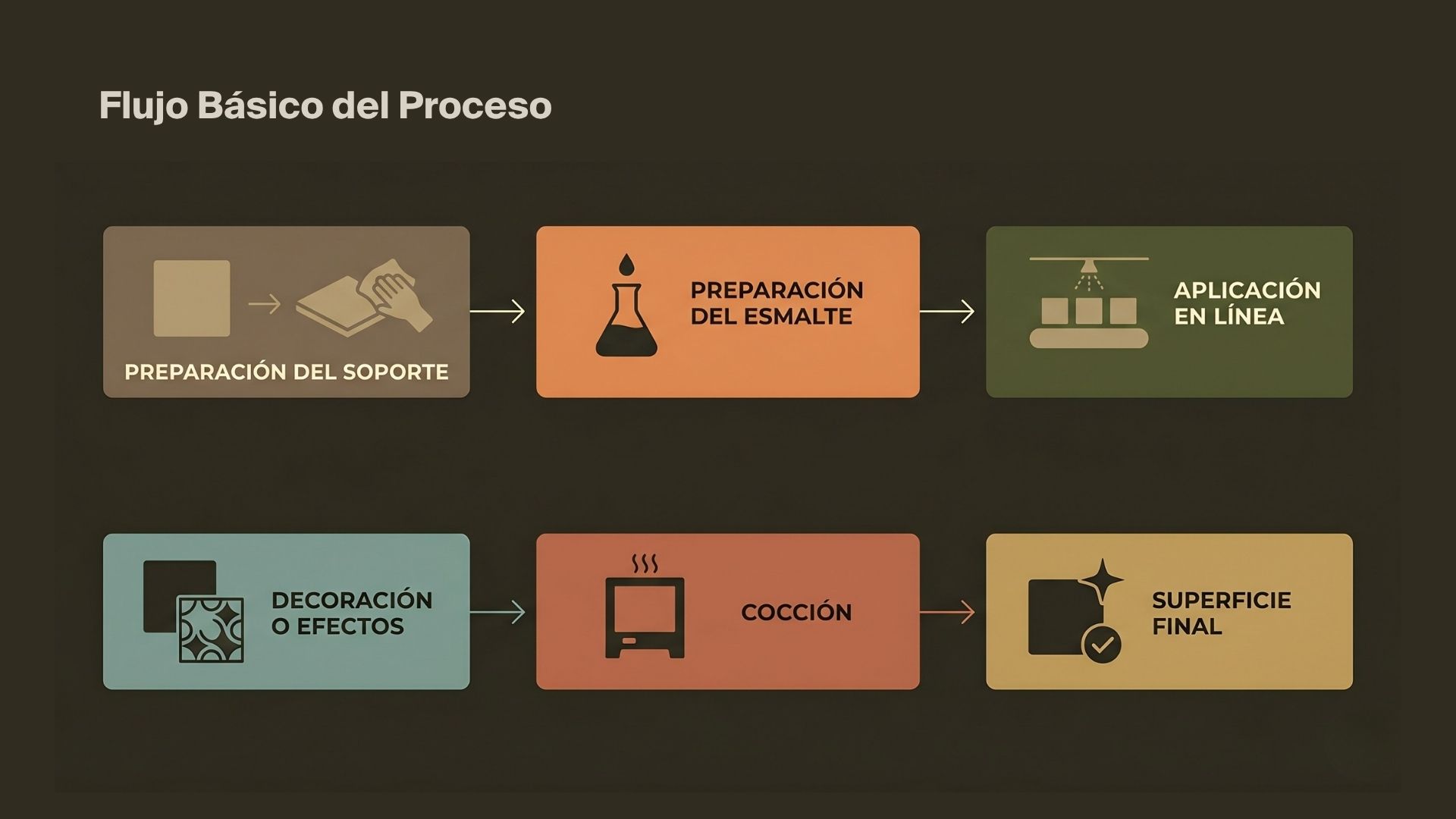
This overview summarises the typical flow of industrial ceramic glazing. Each stage determines the next: poor body preparation can affect application; a poorly adjusted suspension can generate defects; and incorrect firing can alter the final gloss, texture or strength.

Preparation of the body and the glaze itself

Before applying the glaze, the ceramic body must be in the right condition. The surface requires stability, cleanliness, controlled moisture and consistent absorption compatible with the application system.

If the body is not properly prepared, defects such as lack of adhesion, absorption differences, marks, irregularities, pinholes or coverage problems may appear.

The glaze also requires preparation. On an industrial line, it is not enough for the formula to be correct: the suspension must remain stable. Parameters such as density, viscosity, residue, temperature, sieving and agitation are decisive.

Variations in glaze application can cause colour differences, thickness changes or coating defects. Controlling viscosity and density helps to reduce these types of process issues.

On the factory floor, this translates into something very specific: fewer deviations, fewer stoppages and greater certainty in the result.

Main in-line application methods

In the ceramic industry, there are different methods for applying glazes, engobes, grits or decorations. The choice depends on the product type, the desired finish, the line speed and the final performance features.

Among the most common methods, we find spraying, bell or nozzle application, dry application, digital systems, rollers, airless booths and other systems adapted to specific needs.

Application techniques have evolved significantly in ceramic tile manufacturing, particularly due to the need to develop new aesthetic finishes and better surface performance. Qualicer 2023 specifically addressed the adaptation of inks and glazes to new ceramic glazing and decoration techniques.

Each method has its own logic. Spraying can be useful for certain layers or finishes. Digital application allows effects and decorations to be worked with high precision. Grits or micro-grits require systems that ensure regular distribution. And the bell remains a highly relevant technique when a continuous and homogenous application on industrial pieces is required.

Curtain glazing: advantages for industrial pieces

Curtain glazing in industrial ceramic pieces consists of passing the piece under a continuous curtain of glaze. The suspension falls regularly, covering the surface as the piece moves along the line.

This system can also be referred to as waterfall, nozzle, bell or waterfall application, depending on the technology used and the context. SACMI describes its curtain systems for ceramics as solutions for the waterfall application of glazes, engobes, transparent glazes (cristalinas) and micro-grits.

Its main advantage is the ability to generate a relatively homogenous and continuous layer, which is particularly valuable on industrial lines where repeatability is key.

In practical terms, curtain glazing can help when seeking uniform application, good coverage and stability in mass production. However, it also demands control: flow rate, viscosity, density, line speed, system cleanliness and curtain consistency are factors that must be kept within appropriate ranges.

When working well, the curtain brings fluidity to the process. When poorly adjusted, it can generate marks, thickness differences, bubbles, build-ups or surface defects.

That is why, as with almost everything in industrial ceramics, the key lies not just in the method. It is in the fine-tuning.

The importance of the firing and vitrification phase

Firing is the moment when the glaze fully develops its properties. During this phase, the components react, partially melt, integrate with the surface and generate the final layer.

Vitrification is the process that allows the glaze to acquire its definitive appearance and performance. Temperature, cycle, kiln atmosphere, body composition and interaction with the glaze all determine the outcome.

If firing is insufficient, the glaze may remain under-developed, resulting in a lack of gloss, low resistance or poor compaction. If it is excessive or not properly adjusted, deformations, bubbles, shade variations, loss of texture or stability problems may appear.

The firing phase does not “fix” a bad application, but it can enhance or ruin a good formulation.

Therefore, the glaze must be designed with the actual manufacturing process in mind. Not for an ideal scenario, but for the specific line where it will operate.

Criteria for choosing the right ceramic glaze for your product

Choosing a ceramic glaze should not start with the colour. It should start with the product.

Before choosing a ceramic glaze, it is advisable to review some key aspects.

1. Type of piece
Formulating for floor tiles is not the same as formulating for wall tiles. Floor tiles usually demand greater wear resistance, better surface behaviour and, in some cases, anti-slip properties. Wall tiles, on the other hand, may prioritise aesthetic richness, gloss, texture or visual depth.

2. Final use
Indoor, outdoor, wet areas, commercial spaces or high traffic. The context of use defines the level of technical requirement. A piece for a bathroom, a façade, a shop or a private home does not face the same type of wear or the same conditions of use.

3. Desired finish
Matt, gloss, satin, mineral texture, sugar effect, anti-slip finish or high-resistance surface. Each finish requires a specific formulation and application. Aesthetics are important, but they must be aligned with the expected behaviour.

4. Application method
The glaze must adapt to the glazing system: curtain, bell, spraying, digital application, grit application or other in-line methods. A glaze may have a suitable formulation but fail to work well if it does not respond to the actual application system.

5. Firing curve
Kiln temperature and cycle determine the development of the glaze. A good result depends on the formulation being designed for that actual process, with its specific times, atmosphere, body and conditions.

6. Production stability
The glaze must be reproducible regularly, batch after batch, avoiding shade variations, surface defects or application issues. In the industry, a good glaze is not one that works once, but one that maintains its behaviour consistently.

When these questions are properly answered, the glaze ceases to be a mere application material and becomes an industrial solution.
Glaze as a balance between design, process and performance

An industrial ceramic glaze must respond to three dimensions at the same time.

Design
Colour, gloss, texture, visual depth and final finish.

Process
Stable application, controlled viscosity, compatibility with the line and good firing response.

Performance
Strength, impermeability, cleanliness, durability and behaviour in use.

A good industrial ceramic glaze is not just one that offers an attractive finish. It is one that manages to maintain that finish in a stable, efficient and repeatable manner within the production process.

Kerafrit: innovation and technical support for your glazing process

At Kerafrit, we understand ceramic glazes from a comprehensive perspective: composition, application, firing, surface and final result.

Our work is not limited to developing products. We support each client to find the most suitable solution based on their line, their collection, their technical objectives and their production needs.

This perspective is particularly important in an industry where every detail counts. The choice of a frit, the adjustment of a pigment, the behaviour of a grit, the stability of a suspension or the adaptation of a glaze to an application system can make the difference between a correct surface and a truly distinctive one.

Kerafrit operates across different solution areas linked to surface aesthetics, anti-slip solutions, surface resistance and process stability, with products such as glazes, grits, digital effects, protective coatings, inks, additives and solutions aimed at improving industrial performance.

Innovation is not always visible to the naked eye. Sometimes it lies in ensuring that a finish maintains its gloss without losing stability. In making a texture more consistent. In making a glaze respond better to a specific line. In ensuring that a surface is beautiful, but also resistant, reproducible and viable.

That is where technical support delivers value.

Because in industrial ceramics, the best glaze is not just one that offers a good finish. It is the one that fits the process, reduces uncertainty and helps to manufacture with confidence.

The glaze as a meeting point between design, technique and production

Ceramic glazes are an essential part of the final value of a piece. They protect, beautify, differentiate and provide performance features. However, their true potential appears when they are formulated and applied taking the entire industrial process into account.

From composition to firing, every decision influences the result. Frits, pigments, grits, additives, the application method and the body work together to create a meaningful surface.

Therefore, choosing a glaze is not just a product decision. It is a technical, aesthetic and industrial decision.

At Kerafrit, we work to make that decision safer, more precise and more closely connected to what each client needs to create.

Shall we talk?


Frequently asked questions about ceramic glazes

What are ceramic glazes?

Ceramic glazes are coatings applied onto a ceramic body which, after firing, form a vitrified or partially vitrified layer. Their function is to protect the surface and provide the final aesthetic finish.

What are industrial ceramic glazes used for?

They are used to improve the impermeability, strength, cleanliness, colour, gloss, texture and surface behaviour of a ceramic piece. In the industry, they also help to differentiate collections and meet specific technical requirements.

How does the glazing process work in industrial ceramics?

The process includes body preparation, glaze preparation, in-line application, decoration where applicable, and final firing. Each stage must be controlled to ensure stability, repeatability and surface quality.

What is curtain glazing?

Curtain glazing is an application method in which the piece passes under a continuous fall of glaze. It allows the surface to be covered regularly and is used on industrial lines for glazes, engobes, transparent glazes (cristalinas) or micro-grits.

How do I choose the right ceramic glaze?

The choice depends on the type of piece, the final use, the production line, the application method, the desired finish and the necessary technical performance features. It is also important to validate its firing behaviour and its production stability.

Featured Articles

  • Inicio /
  • Blog /
  • Industrial ceramic glazes: a complete guide to composition, processes and applications