
• Products
  • Services
  • About us
  • Blog
Innovation 23 July 2026

Properties of ceramics: what determines their technical and aesthetic performance

Sayo Flors Rogla

Written by

Sayo Flors Rogla

Share

The properties of ceramics explain why this material continues to be one of the most widely used solutions in architecture, interior design, industry and surface design.

Strength, durability, stability, water resistance, thermal performance, chemical resistance, touch, gloss and safety are just some of the variables that define the performance of a ceramic piece.

However, in the ceramic industry, it is not enough to discuss ceramics as a generic material. A tile, a technical flooring solution or a glazed surface is the result of many interconnected decisions: composition, milling, pressing, drying, firing, glaze, ink, grits, texture, finish and final application.

That is why, when we talk about the properties of ceramics, we are referring to something that begins long before the visible surface.

We are talking about materials.
About processes.
About formulation.
About design.
And about the ability to transform a specific requirement into a stable, functional surface that is consistent with its intended use.

Key takeaways from this article

  • The properties of ceramics can be grouped into physical, mechanical, chemical, thermal, functional and aesthetic properties.

  • In ceramic tiles, many performance characteristics are validated using specific standards and testing methods, such as the ISO 10545 series.

  • Water absorption, mechanical strength, abrasion resistance, chemical resistance and thermal performance are essential for determining the appropriate application of a ceramic piece.

  • A ceramic surface is not merely a decorative layer: it provides touch, gloss, texture, grip, protection and aesthetic value.

  • The best results are achieved when design, laboratory and production teams work together from the outset.

What do we mean by the properties of ceramics?

The properties of ceramics are the set of characteristics that determine how a ceramic piece responds to different conditions of use, manufacturing and maintenance.

These properties may be:

  • Physical, such as water absorption, porosity or density.

  • Mechanical, such as flexural strength, breaking load or abrasion resistance.

  • Chemical, such as resistance to stains, cleaning products or chemical agents.

  • Thermal, such as resistance to thermal shock or stability when exposed to temperature changes.

  • Functional, such as slip resistance, cleanability, safety or performance in wet areas.

  • Aesthetic, such as colour, gloss, matt finishes, relief, visual depth or touch.

The American Ceramic Society defines ceramic materials as inorganic, non-metallic materials and identifies high hardness, good wear resistance, chemical resistance, dimensional stability and low ductility, among others, as some of their common properties. However, these characteristics must always be interpreted according to the type of ceramic material, its composition, microstructure and specific application.

In the case of ceramic tiles, the ISO 13006 standard establishes definitions, classification, characteristics and marking requirements for first-quality commercial ceramic tiles.

What determines the properties of a ceramic surface?

The performance of a ceramic surface does not depend on a single variable. It is determined by the balance between the body, formulation, applied layers and production process.

Some of the most relevant factors include:

  • The composition of the ceramic body.

  • The particle size distribution of the raw materials.

  • The porosity of the body.

  • The drying and firing cycle.

  • Compatibility between the body, engobe, glaze and decoration.

  • The formulation of glazes, frits, inks, grits and protective coatings.

  • The application technology.

  • The final finish: matt, glossy, polished, structured, slip-resistant or technical.

  • Actual production conditions.

That is why two apparently similar ceramic pieces may perform very differently.

A matt finish may require specific protection to improve its wear resistance. A textured surface can provide greater grip, but it must also remain easy to clean. A digital ink can define the graphic design of a ceramic piece, but it requires stability, compatibility with the system and consistent behaviour during firing.

At Kerafrit, we develop each solution as part of a complete system. Our ceramic frits, ceramic glazes, digital inks, ceramic grits and ceramic additives do not work in isolation. Each material performs a specific function within the final result.
propiedades físicas de la cerámica

Physical properties of ceramics

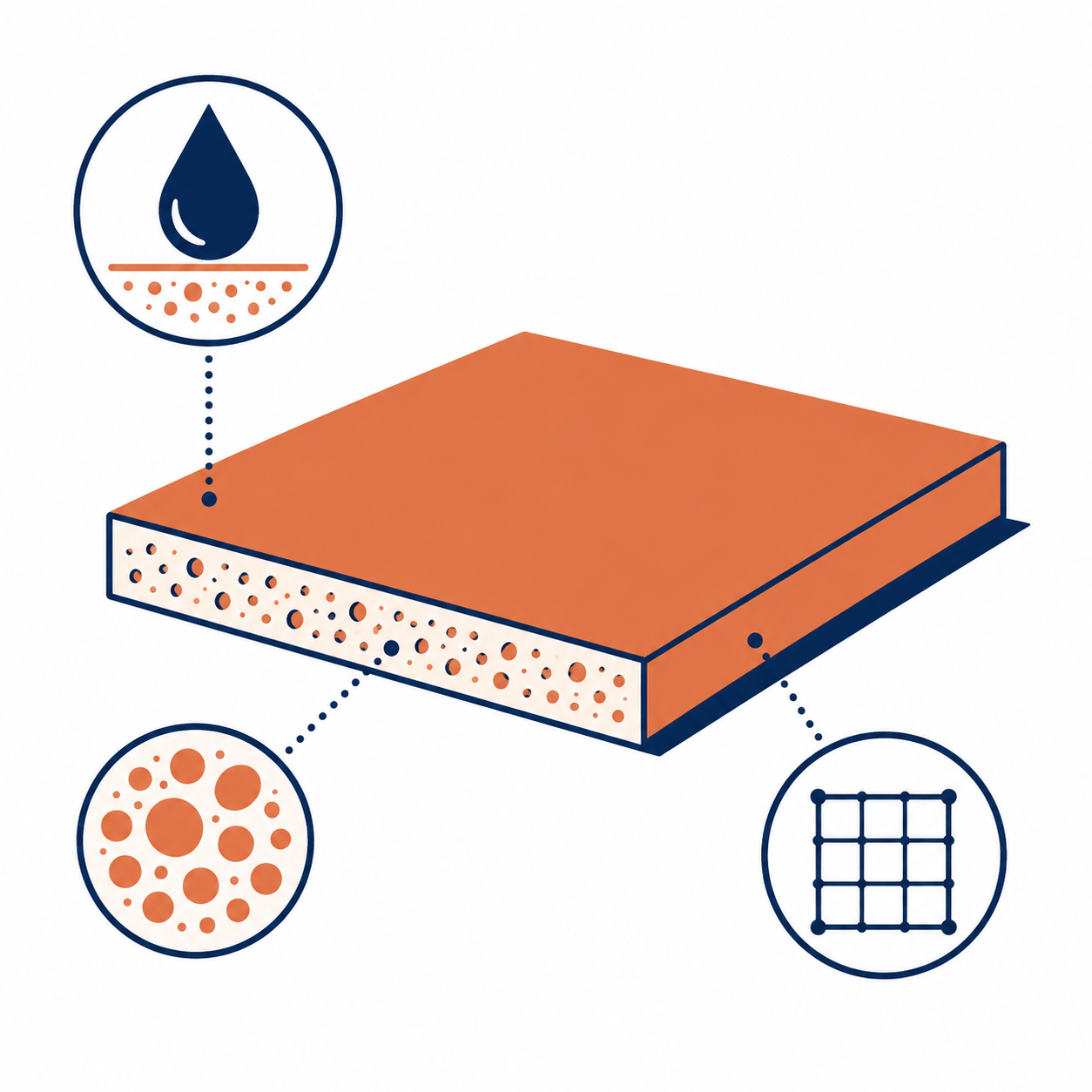
Physical properties describe how ceramics behave as a material in relation to variables such as water, density, porosity and dimensional stability.

Water absorption and porosity

Water absorption is one of the most important properties of ceramic tiles.

It is related to the open porosity of the ceramic piece and helps determine its classification, its behaviour when exposed to moisture and its suitability for specific applications.

An interior wall covering does not have the same requirements as outdoor flooring, a ventilated façade, a swimming pool or a wet area. In these cases, water absorption must be assessed alongside other variables such as frost resistance, slip resistance, maintenance and intended use.

ISO 10545-3 specifies a method for determining water absorption, apparent porosity, apparent relative density and bulk density in ceramic tiles. It also states that this method is applicable to tile classification and product specifications.

Density and dimensional stability

Density and dimensional stability influence the performance of a ceramic piece during manufacturing, transport, installation and final use.

In large-format pieces, for example, dimensional stability is particularly important. Any deviation can affect installation, flatness, visual continuity and the perceived quality of the finished product.

Stability does not depend solely on the ceramic body. Compatibility between layers, the thermal cycle and the behaviour of the materials applied to the surface also play a role.

Surface hardness

Ceramics are commonly associated with hardness. It is an important property, but it should not be confused with every type of resistance.

A surface may have good hardness while performing differently under continuous abrasion, impact, chemical attack or staining. For this reason, simplistic conclusions should be avoided in ceramic development.

The question is not only whether a surface is hard.
The question is whether it performs effectively in the application for which it was designed.

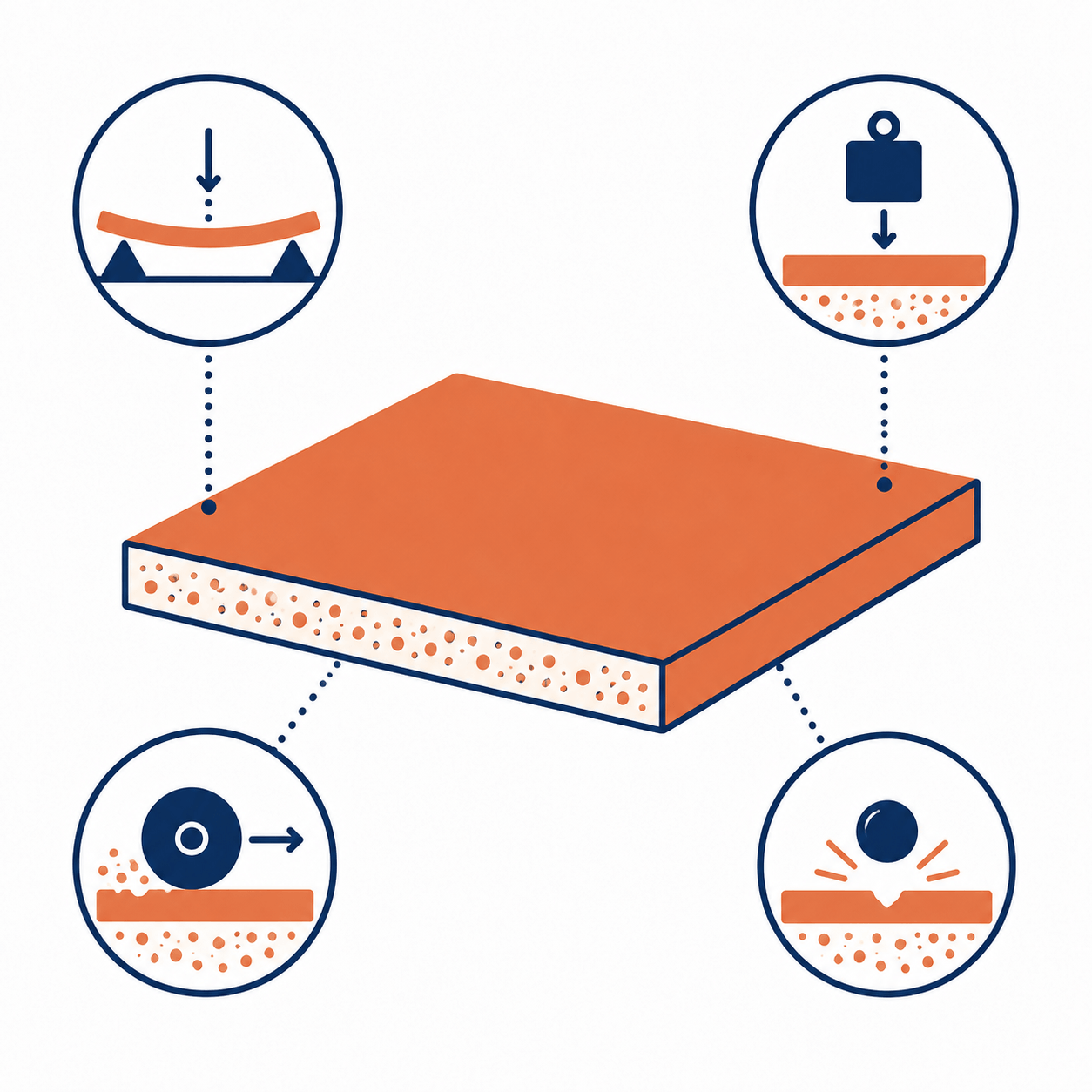
propiedades mecánicas de la cerámica

Mechanical properties of ceramics

Mechanical properties explain how ceramics respond to stress, loads, wear and impact.

They are particularly important in flooring, large-format pieces, commercial spaces, high-traffic areas and technical applications.

Flexural strength and breaking load

Flexural strength and breaking load help assess a tile’s ability to withstand stress without breaking.

ISO 10545-4 specifies the test method for determining the modulus of rupture and breaking strength of ceramic tiles.

In industrial development, this property is influenced by factors such as:

  • Body composition.

  • Compaction.

  • Thickness.

  • Piece geometry.

  • Drying.

  • Firing cycle.

  • Stresses between the body and the surface layers.

In large-format or low-thickness products, this relationship between design, lightness, strength and stability becomes even more important.

Wear and abrasion resistance

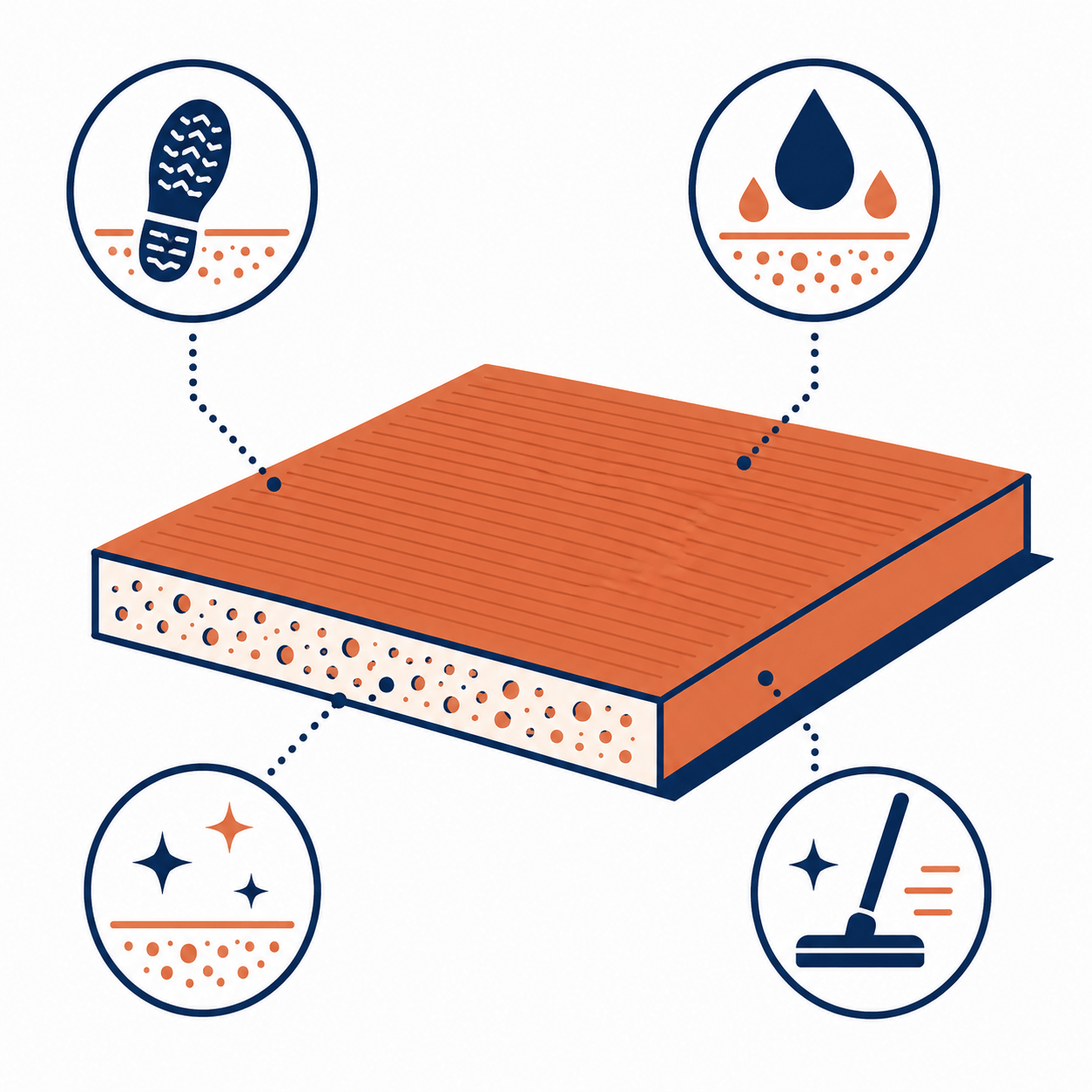
Wear resistance is essential in flooring exposed to foot traffic, frequent cleaning or intensive use.

A decorative wall covering does not have the same requirements as flooring for retail, hospitality, public spaces or commercial areas.

For glazed tiles intended for flooring, ISO 10545-7 establishes a method for determining resistance to surface abrasion.

The surface plays a decisive role here. The type of glaze, protective coating, texture, presence of grits and final finish can significantly affect performance during use.

Ceramic grits, for example, can add volume, texture and technical properties to the final product, provided that they are correctly integrated into the ceramic system.

Impact resistance

Ceramics can offer excellent resistance to compression and wear, but their inherent nature may make them more fragile when exposed to certain types of impact.

For this reason, when a piece is intended for demanding environments, assessing its appearance or hardness alone is not enough. The entire system must be considered: body, thickness, format, application, installation and actual use.

The final resistance does not depend on a single property. It depends on the balance between all of them.

Chemical properties of ceramics

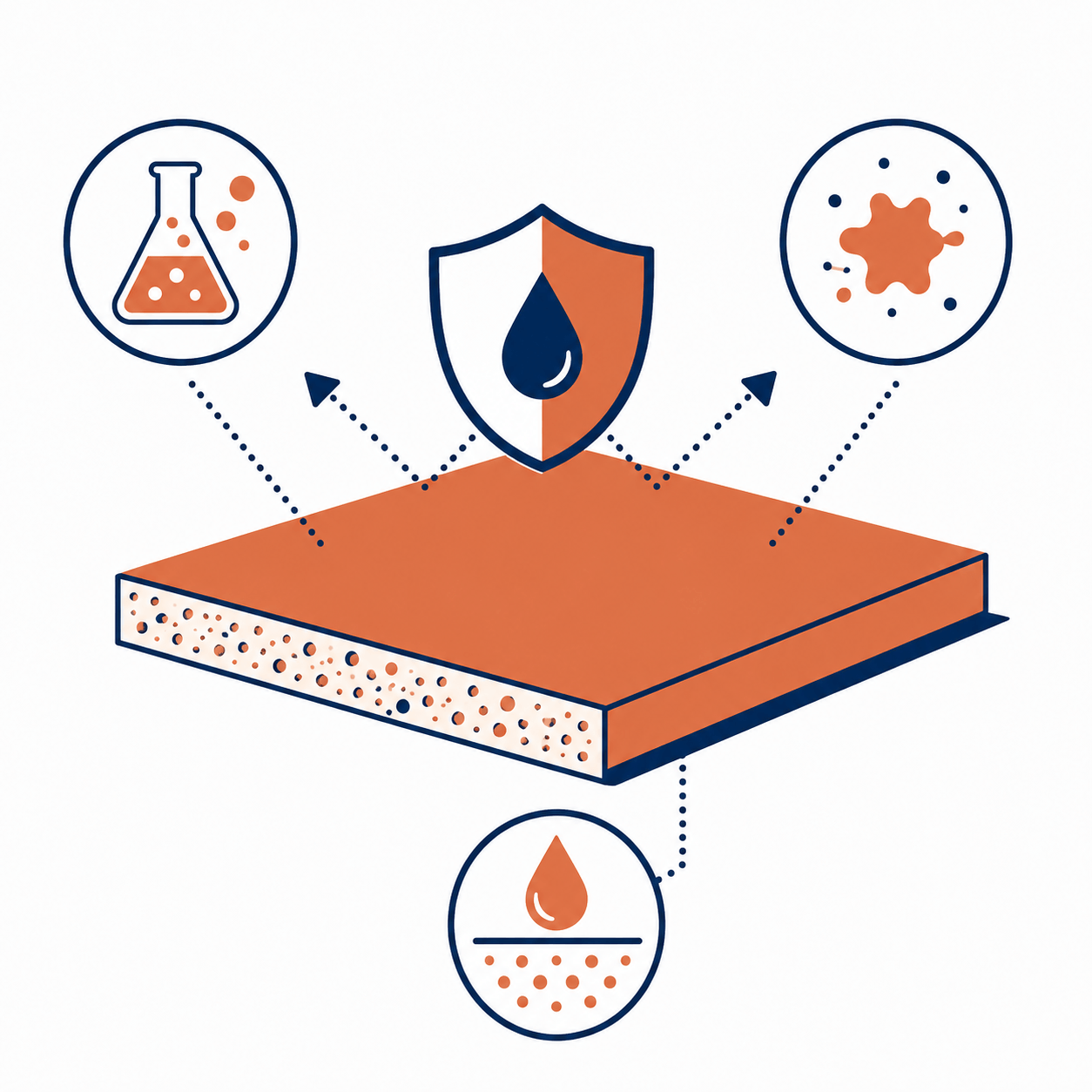
Chemical properties determine how a surface responds to cleaning products, acidic or alkaline agents, stains, moisture, salts and other substances encountered in everyday use.

These properties are essential in kitchens, bathrooms, wet areas, healthcare environments, commercial flooring and surfaces subject to frequent cleaning protocols.

Chemical resistance

Chemical resistance measures a tile’s ability to preserve its surface when exposed to certain chemical agents.

ISO 10545-13 specifies a method for determining the chemical resistance of ceramic tiles at room temperature and is applicable to all types of ceramic tiles.

In a glazed surface, this property depends on the glaze formulation, firing process, nature of the vitreous layer, texture and surface protection.

For this reason, a technical surface must be designed with its intended environment in mind.

Stain resistance

Stain resistance is a key performance characteristic in terms of perceived cleanliness and durability.

A surface may be visually appealing, but if it retains dirt, grease or pigments from everyday use, its functional value is reduced.

ISO 10545-14 specifies a method for determining the stain resistance of the working surface of ceramic tiles.

This property requires particular attention in matt, micro-textured or low-reflectance finishes. Texture adds visual and tactile value, but it must be balanced with adequate cleanability and protection suited to the final application.

propiedades térmicas de la cerámica

Thermal properties of ceramics

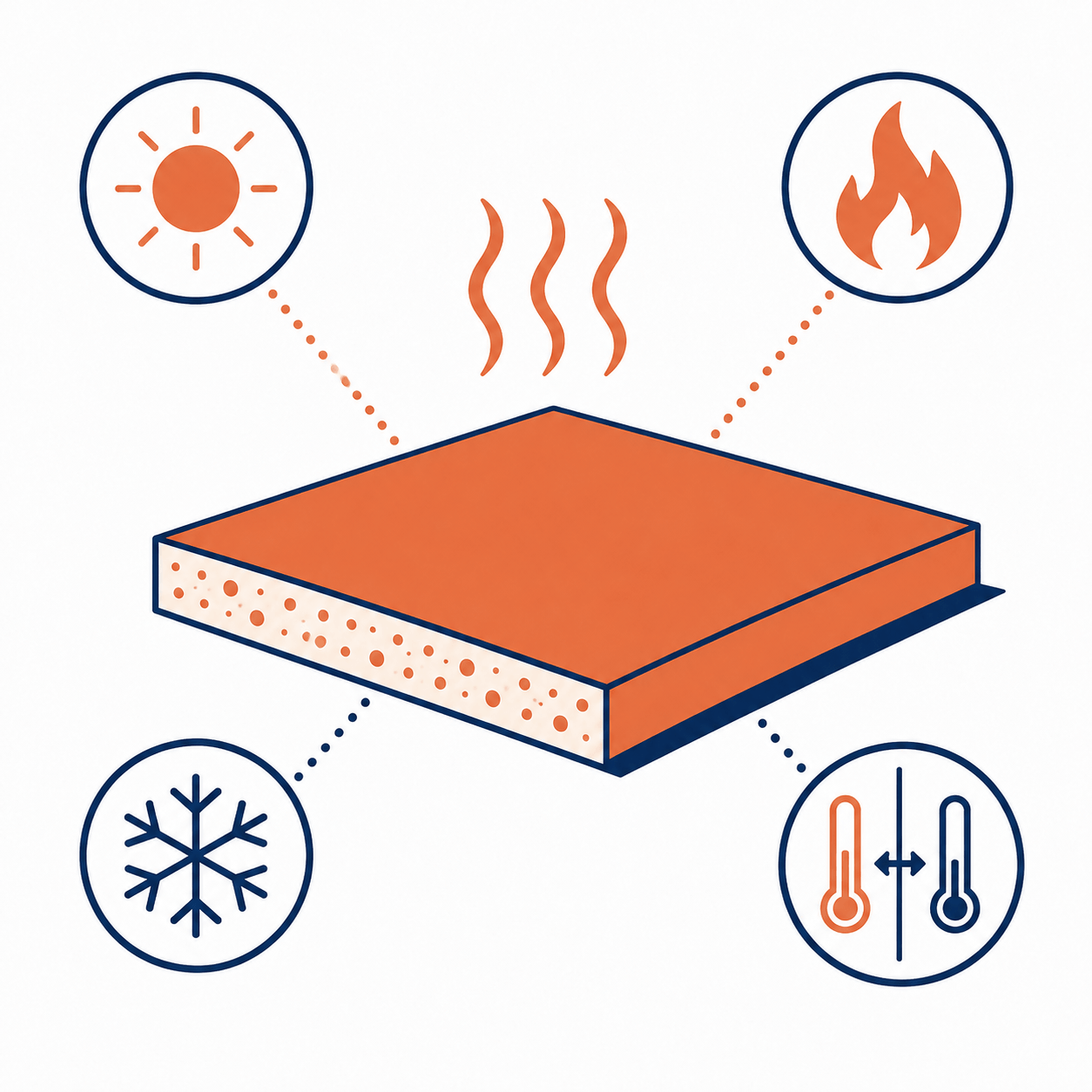
Ceramics are manufactured through thermal processes and, in many cases, are also used in environments where they may be exposed to temperature changes.

For this reason, thermal properties are essential both during production and throughout the service life of the ceramic piece.

Thermal shock resistance

Thermal shock occurs when a ceramic piece is exposed to sudden changes in temperature.

ISO 10545-9 specifies a test method for determining the thermal shock resistance of ceramic tiles under normal conditions of use.

This property is related to composition, microstructure, porosity, thermal expansion and compatibility between the body and the applied layers.

Thermal expansion and compatibility between layers

During firing, each material undergoes transformation.

The body, engobe, frit, glaze, ink and grit do not behave independently. They all form part of the same system exposed to high temperatures.

For this reason, thermal compatibility is a critical variable. If the materials do not perform well together, defects may occur, including stresses, crazing, colour variations, loss of effect, bubbles or adhesion problems.

Ceramic frits play a fundamental role in this area, as they help stabilise glaze formulations, control thermal behaviour and achieve finishes that are consistent with the production cycle.

propiedades funcionales de la cerámica

Functional properties of ceramic surfaces

The surface is the part we see, touch and use. However, it is not merely an aesthetic layer.

It also defines grip, tactile feel, gloss, cleanability, protection and user experience.

Slip resistance

Safety is a priority in outdoor flooring, wet areas, swimming pools, terraces and public spaces.

Slip resistance does not depend solely on adding roughness. Texture, micro-relief, particle size, protective coatings, finish, glaze type and conditions of use all play a role.

A slip-resistant solution must provide grip without compromising the aesthetics of the piece or affecting its tactile feel or cleanability.

To explore this topic in greater detail, you can read our article on slip resistance in porcelain flooring for swimming pools and wet areas.

Tactile feel and texture

Tactile feel has become an increasingly important property in ceramic design.

Surfaces are no longer valued solely for how they look, but also for how they feel.

Micro-reliefs, silky finishes, subtle structures, matt grits, synchronised effects and contrasts between smooth and textured areas make it possible to create more sensory and distinctive ceramic pieces.

The challenge lies in preserving this tactile value without compromising stability, resistance, cleanability or production feasibility.

Gloss, matt finishes and interaction with light

Gloss and matt finishes are not merely visual decisions.

They affect the perception of colour, the depth of the graphic design, the visibility of the relief and the way the piece interacts with light.

A localised gloss effect can enhance a vein.
A deep matt finish can convey calm and naturalness.
A controlled contrast can create greater visual depth without overloading the surface.

Digital inks make it possible to create details, gradients, effects and precise graphics. Combined with glazes, grits and protective coatings, they help develop surfaces in which aesthetics and technical performance progress together.

propiedades estéticas de la cerámica

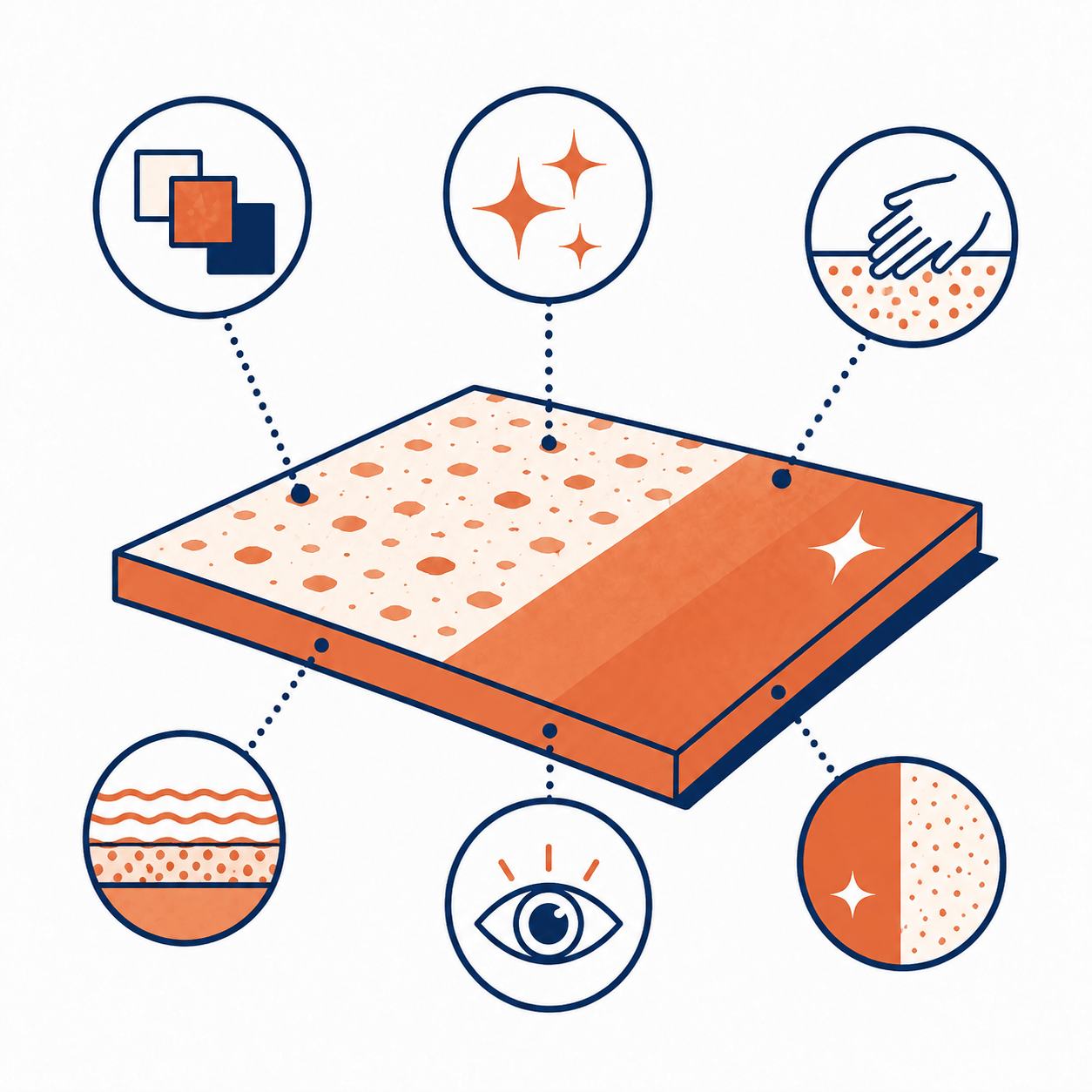
Aesthetic properties: when technique also defines design

In industrial ceramics, aesthetics do not come at the end of the process. They are built from the very beginning.

Colour, veining, relief, texture, gloss, matt effects and visual depth depend on highly specific technical decisions:

  • Which glaze is used.

  • Which frit supports the system.

  • Which ink reproduces the graphic design.

  • Which grit adds texture or volume.

  • Which protective coating is applied.

  • How the entire system behaves after firing.

  • How the effect is maintained during production.

For this reason, a surface is not defined solely by a reference image. It is defined through the dialogue between design, laboratory and the production line.

Through our surface design and trends service, we work to transform inspiration, references and product requirements into viable, stable ceramic solutions adapted to the market.

Because a good surface must not only look good.
It must be manufactured effectively.
It must be reproduced consistently.
It must perform effectively.

How the properties of a ceramic tile are validated

The properties of a ceramic tile must be validated through tests, controls and trials adapted to its intended use.

It is not enough to claim that a surface is resistant, durable or safe. These characteristics must be verified using appropriate methods.

Some of the most relevant standards for ceramic tiles include:

  • ISO 13006, for the definitions, classification, characteristics and marking of ceramic tiles.

  • ISO 10545-3, for water absorption, apparent porosity, apparent relative density and bulk density.

  • ISO 10545-4, for modulus of rupture and breaking strength.

  • ISO 10545-7, for resistance to surface abrasion in glazed tiles used for flooring.

  • ISO 10545-9, for thermal shock resistance.

  • ISO 10545-13, for chemical resistance.

  • ISO 10545-14, for stain resistance.

Each project may require additional validations depending on the market, applicable regulations and the intended use of the ceramic piece.

Which properties should be prioritised according to the ceramic application?

There is no single universal property that can address every requirement. The key is to prioritise according to the application.

Application

Key properties

Interior wall covering

Aesthetics, cleanability, visual stability, stain resistance

Residential flooring

Wear resistance, tactile feel, ease of cleaning, safety

Commercial flooring

Abrasion resistance, chemical resistance, durability, maintenance

Outdoor applications

Low water absorption, frost resistance, slip resistance, stability

Swimming pools and wet areas

Slip resistance, low water absorption, chemical resistance

Large-format products

Dimensional stability, mechanical strength, lightness, finish

Technical surfaces

Functional performance, safety, process control, repeatability

This approach makes it possible to make better decisions from the beginning of the development process.

Technical flooring may require greater slip resistance. A decorative wall covering may prioritise texture, visual depth and colour stability. A high-traffic surface will require abrasion resistance, cleanability and protection.

Each property is meaningful when it responds to a real application.

How we develop these properties through formulation

At Kerafrit, we do not view properties as isolated values on a technical data sheet.

We understand them as part of a shared process.

We listen to the objectives of the project, analyse production conditions and work with you to adjust the solution: from glaze formulation to application, from the behaviour of a suspension to the final finish.

Ceramic additives make it possible to control the rheological, physical and chemical properties of suspensions, helping to stabilise the material during preparation, application and firing.

Digital inks provide graphic definition, stability and reliability in industrial printing, with parameters such as viscosity, surface tension and particle distribution adjusted to ensure consistent application.

Ceramic grits add volume, texture and technical properties to the final product and can be adapted to different particle sizes and finishing requirements.

Our specialised technical support also enables us to assist throughout the development process, from the laboratory to production-line validation, adjusting formulations, process parameters and actual production performance.

Because final quality is not built only at the end.
It is built through every decision made during the process.

Frequently asked questions about the properties of ceramics

What are the main properties of ceramics?

The main properties of ceramics are physical, mechanical, chemical, thermal, functional and aesthetic. These include water absorption, porosity, mechanical strength, wear resistance, chemical resistance, thermal performance, tactile feel, gloss, finish and surface safety.

Why are ceramics resistant?

Ceramics generally offer high hardness and mechanical strength, as well as thermal, functional and aesthetic properties. These include water absorption, porosity, mechanical strength, wear resistance, dimensional stability and chemical resistance due to their composition, structure and firing process. However, their actual performance depends on the type of ceramic material, formulation, microstructure and intended use.

Which property determines whether a ceramic tile is suitable for outdoor use?

For outdoor applications, several properties must be assessed together: water absorption, frost resistance where applicable, slip resistance, dimensional stability, mechanical strength, maintenance requirements and suitability for the intended environment.

Are matt ceramics less resistant than glossy ceramics?

Not necessarily. Resistance does not depend solely on whether the surface is matt or glossy. It depends on the glaze formulation, protective coating, texture, firing process and the corresponding tests. A matt finish can be technical and resistant when it is correctly developed.

What is the difference between hardness and wear resistance?

Hardness describes the resistance of a surface to a localised action, while wear or abrasion resistance assesses how the surface responds to repeated or continuous use. They are related properties, but they are not equivalent.

How is water absorption measured in ceramics?

In ceramic tiles, water absorption is determined using standardised methods such as ISO 10545-3, which also covers apparent porosity, apparent relative density and bulk density.

Why is the surface important to the properties of ceramics?

Because the surface is the part that comes into contact with actual use. It defines tactile feel, gloss, matt effects, texture, grip, cleanability, stain resistance, protection and aesthetic perception. For this reason, surface development must form part of the technical strategy from the outset.

The best property is the one that meets the needs of your project

The properties of ceramics cannot be understood as a fixed list of characteristics.

Each project requires a different combination.

An outdoor surface must prioritise safety and stability.
Commercial flooring requires resistance and ease of maintenance.
A large-format collection seeks visual continuity and precision.
A piece inspired by natural stone requires depth, tactile appeal and repeatability.
A technical surface must perform without compromising design.

At Kerafrit, we work with you to find that balance.

Because behind every surface that performs effectively, there is technical expertise, listening, testing and people creating together.

The soul behind the surface.

References

ASCER, “Principales Datos sector Español de fabricante de azulejos y pavimentos cerámicos”, 2025, https://portal.ascer.es/wp-content/uploads/2026/04/Datos-2025.pdf

ITC-AICE, “proyecto LIFE REPLAY”, 2025, https://www.itc.uji.es/obtenemos-tintas-ceramicas-inkjet-sostenibles-con-el-proyecto-life-replay/

ASEBEC + ITC Autores: Instituto de Tecnología Cerámica (ITC-AICE) José Gustavo Mallol Gasch, Juan Boix Palomero, Juan Ignacio, Cantero Ramis Margarita García Corcoles, Juan Miguel Tiscar Cervera, Alfredo Beltrán Gonzalez, “Guía ASEBEC 4.0”, 2020, https://spanishceramictechnology.com/wp-content/uploads/2021/04/Guia_Asebec_ITC_.pdf

Featured Articles

  • Inicio /
  • Blog /
  • Properties of ceramics: what determines their technical and aesthetic performance