We develop ceramic engobes formulated to even out and seal the substrate, enhance compatibility with the glaze, and ensure a stable finish in industrial production.
Engobes
At Kerafrit, we tailor each engobe to the characteristics of the ceramic body and actual manufacturing conditions. We adjust parameters such as rheology, application, opacity, permeability, the coefficient of expansion, and firing behavior to achieve stable integration between the body, engobe, and glaze.
In processes involving digital inkjet decoration, a homogeneous base also enhances color development, graphic definition, and the clarity of the final result.
Titanium oxide base
Engobe formulated with titanium oxide to provide coverage and stability, improve the uniformity of the substrate, and promote a homogeneous final finish.
Zirconium oxide base
Engobe with high whiteness and opacity, developed to mask the color of the clay body and create a clean base for subsequent decorative applications
Waterproof engobe
Technical solution designed to control permeability and reduce the appearance of water marks, irregularities, and other surface defects during drying and firing.
High and low coefficient of expansion
Engobes formulated with different coefficients of expansion to improve compatibility between the body, the engobe, and the glaze across various substrates and firing cycles.
Super white
High-whiteness engobe that creates a uniform, luminous base, especially suitable for light finishes and digital decorations with demanding color requirements.
Rib goube
Engobe specifically for the back of the tile, formulated to improve the piece's behavior as it passes over the kiln rollers.
Big Slab: engobe for large-format tiles
Engobe developed for large-format pieces, designed to improve uniformity, dimensional stability, and stress control during the production process.

Homogeneous base that unifies the support and enhances the final appearance.
It promotes adhesion between paste and enamel, reducing surface defects.
Improves color reading and stability in inkjet decorations.
High coefficient or stain-resistant engobes depending on the product requirements.
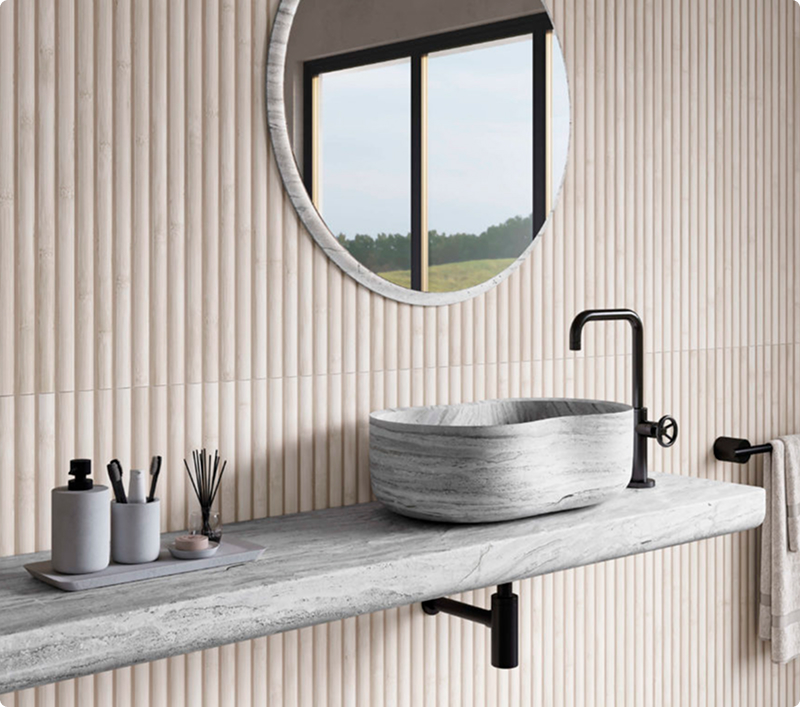
It evens out the background and enhances the cleanliness of the finish and decoration.
Designed to match tensions and improve fit with the system.
Designed for greater coverage and stain resistance on demanding surfaces.
Base prepared to promote color development in inkjet applications.
Yes. We formulate engobes designed for various temperature ranges and firing cycles, adjusting their fusibility, rheology, opacity, and coefficient of expansion to the specific conditions of each production line.
To achieve this adaptation, we analyze the behavior of the body, glaze, decorative applications, and kiln, aiming to create a stable and reproducible system.
Development takes into account the composition and color of the clay body, as well as its shrinkage, absorption, porosity, and coefficient of thermal expansion.
The firing temperature and curve, application thickness, glazing system, and the interaction of the engobe with the glaze, inks, and other decorative materials are also evaluated.
A properly formulated engobe improves background uniformity, promotes color development, and reduces interference with digital inks, ensuring cleaner and more stable decoration in production.
We develop technical engobes that allow for the regulation of the substrate's absorption and permeability during application and drying.
The formulation is adjusted based on the clay body, the application system, and the firing cycle to minimize the occurrence of water marks, shade variations, poor coverage, and other surface irregularities.
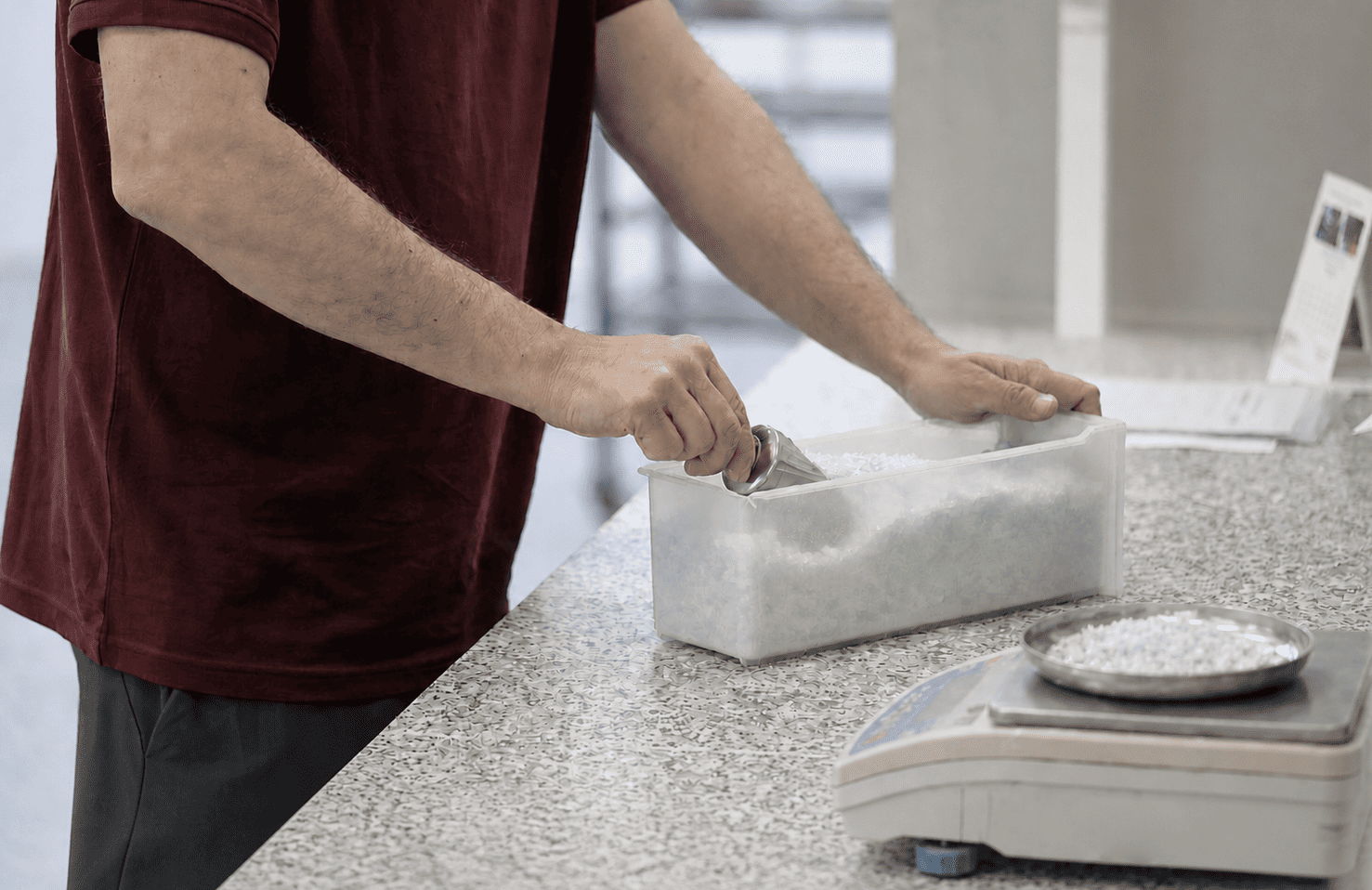
We conduct laboratory tests and formulation adjustments to analyze the combined behavior of the different layers during application, drying, and firing.
When the project requires it, validation continues under industrial conditions to verify the system's stability and its ability to consistently reproduce the result.
Yes. We develop engobes tailored to the requirements of large-format pieces, where application control, uniformity, and thermal behavior are particularly critical.
The formulation is adjusted to the characteristics of the substrate, the dimensions of the piece, and the firing cycle to enhance stability during the process.
Yes. The formulation can be customized based on the technical and aesthetic requirements of each product.
We can adjust properties such as whiteness, opacity, impermeability, the coefficient of expansion, rheology, fusibility, and compatibility with subsequently applied materials.
We support the client from initial trials through to the industrial validation of the engobe.
During implementation, our technical team can adjust both the formulation and key application parameters to ensure stable performance, minimize deviations, and facilitate reproducibility in production.
Technical coatings to optimize adhesion and finish.
On a glazing line, the engobe must maintain stable behavior during application, drying, and firing. Its formulation influences substrate coverage, inter-layer compatibility, the development of the decoration, and the uniformity of the final finish.
For this reason, at Kerafrit, we develop ceramic engobes with the entire production process in mind. We adjust the engobe's composition and physical properties to create a homogeneous base that is compatible with the glaze and designed to meet the demands of industrial manufacturing.
The goal is to facilitate process stability, minimize variations, and achieve consistent results across different production runs and batches.